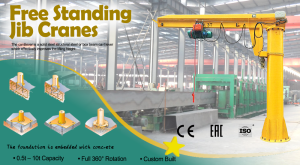
Free Standing Jib Cranes

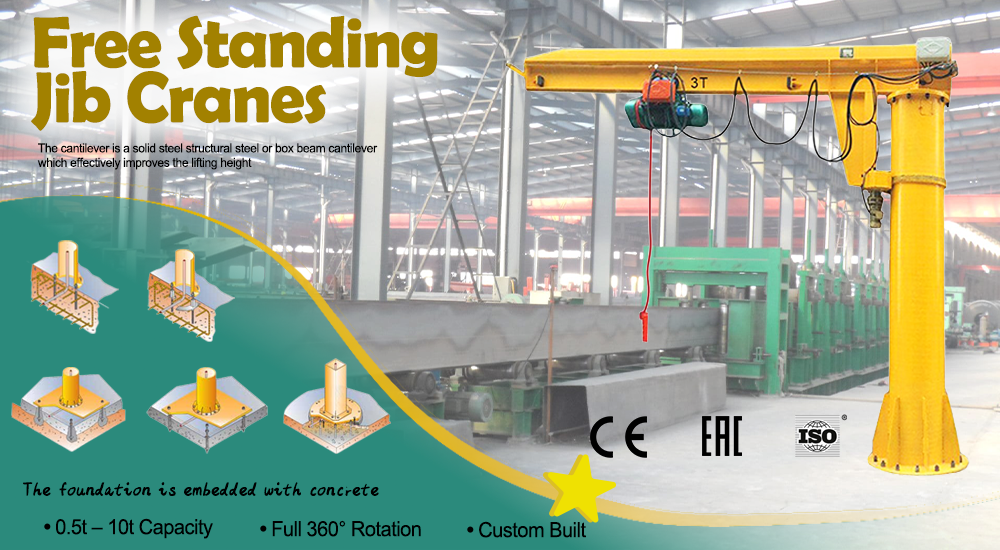
Free-standing jib cranes provide an efficient, space-saving lifting solution for individual workstations, production lines and repetitive material-handling tasks. They can also work alongside overhead bridge cranes to expand handling coverage and improve workflow efficiency.

The crane serves a circular working area around the pillar, making it ideal for short-distance lifting in compact or densely arranged workplaces. Its self-supporting structure allows flexible installation without relying on existing building columns.

Designed for reliable use across a wide range of industries, it combines strong lifting capability with a lightweight, compact structure. It occupies minimal floor space, is straightforward to install and can be configured to suit the required capacity, arm length, lifting height and rotation range.

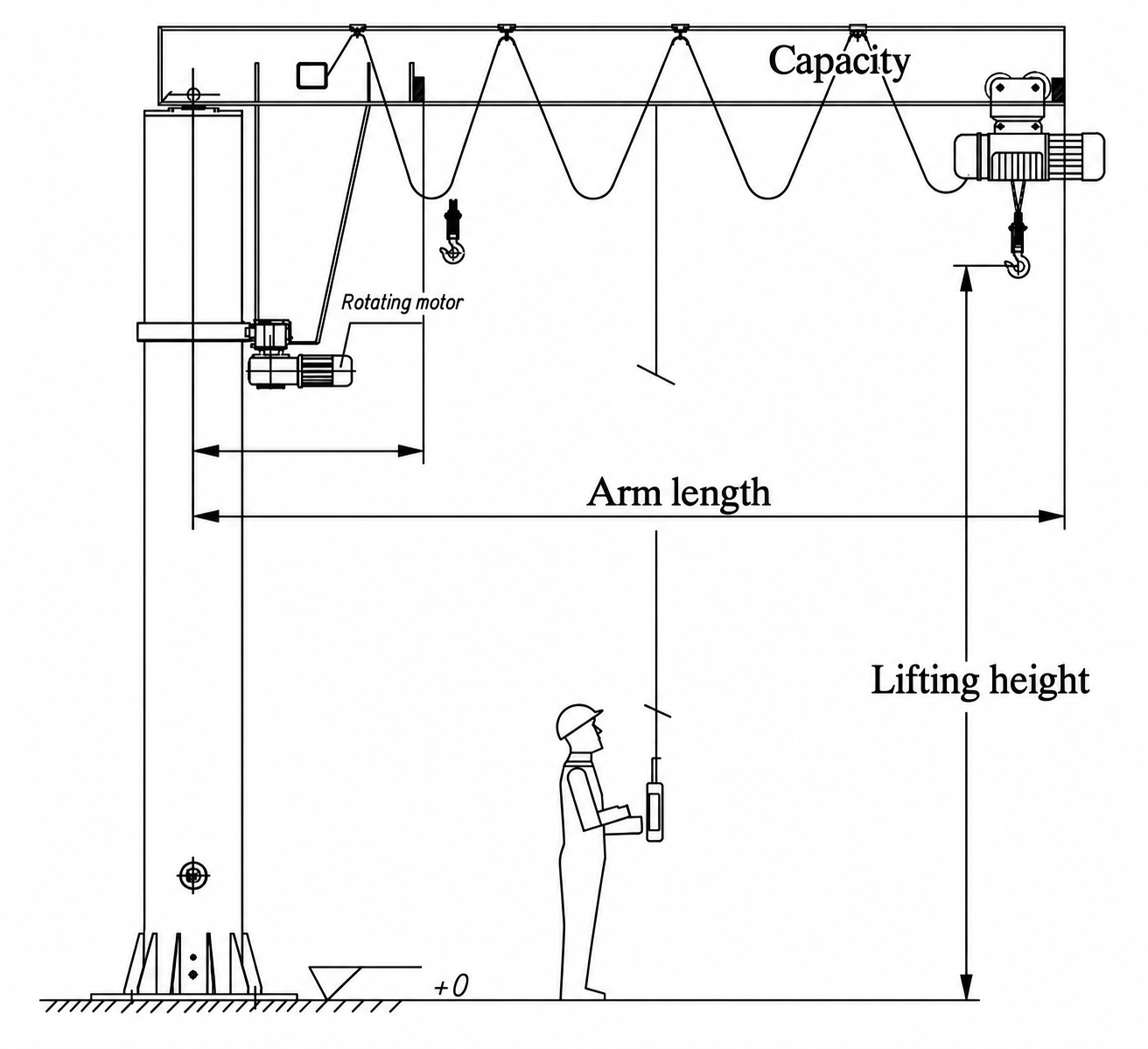
Free standing jib crane dimensions diagram
  • Capacity: Up to 16 tonnes
  • Arm length: Up to 16 m
  • Lifting height: Up to 12 m (floor to underside of boom)
  • Duty class: M3–M5
  • Rotation angle: 120–360°
  • Rated voltage: 220–690 V, 50/60 Hz, 3-phase AC
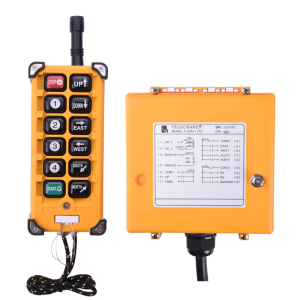
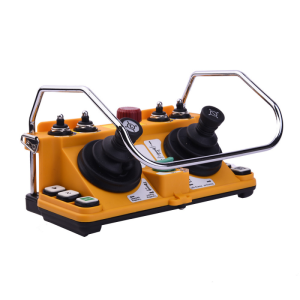
  • Control mode: Pendant control or wireless remote control
Final parameters are subject to engineering confirmation.
Overview

Free Standing Jib Cranes

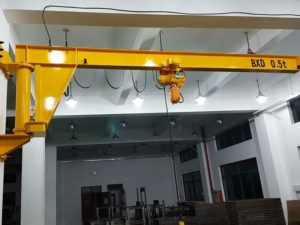
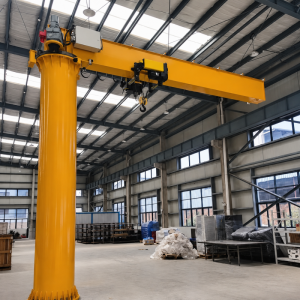
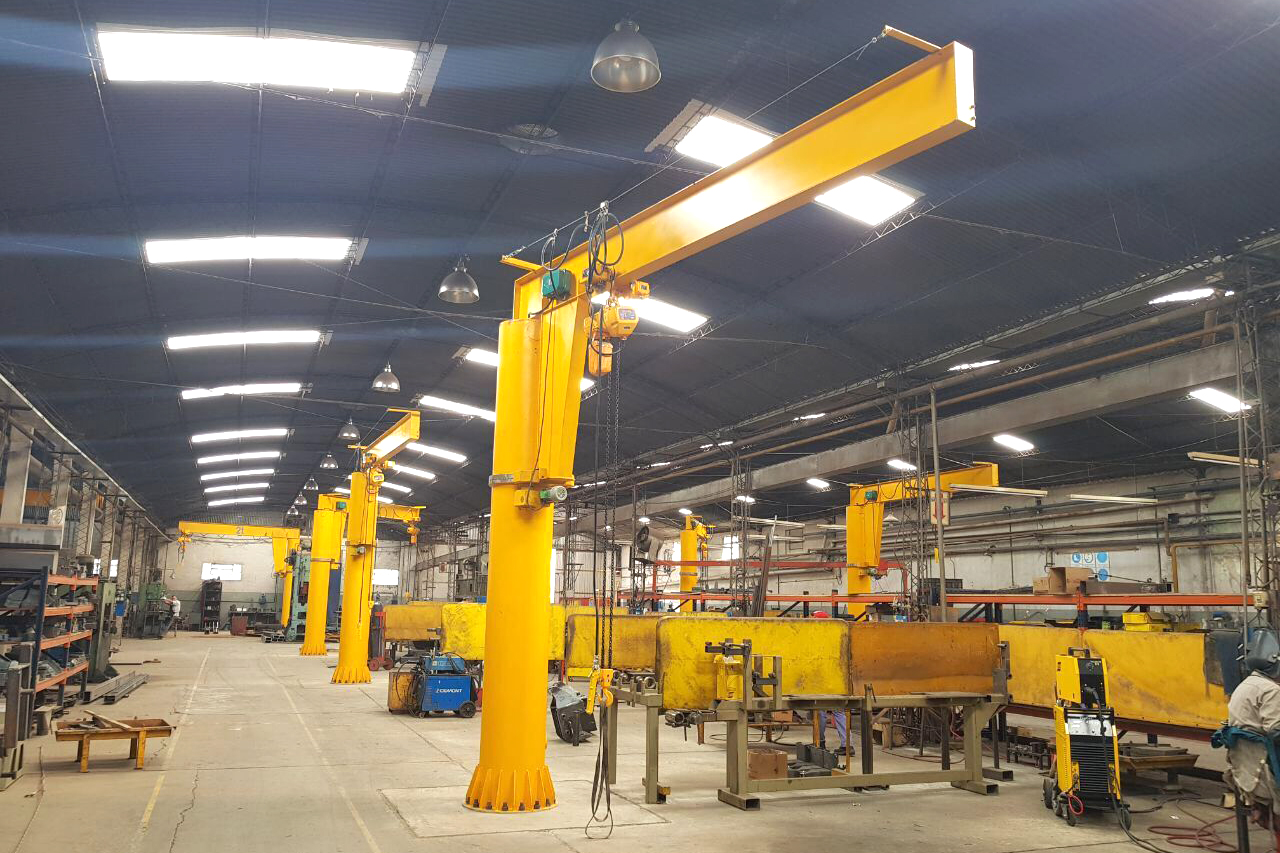
A free standing jib crane consists of a vertical column, a slewing jib arm and a lifting mechanism. Its compact footprint makes efficient use of limited workshop space while providing a wide circular working area for repetitive lifting, loading and positioning tasks.

Depending on the application, jib-crane systems can be floor-mounted or wall-mounted, with electric or manual hoists selected to suit the required capacity and operating frequency. Free standing jib cranes are widely used in workshops, assembly lines, loading areas, docks, ports and shipyards. They can operate independently, complement overhead cranes or serve as dedicated lifting equipment for individual production stations.

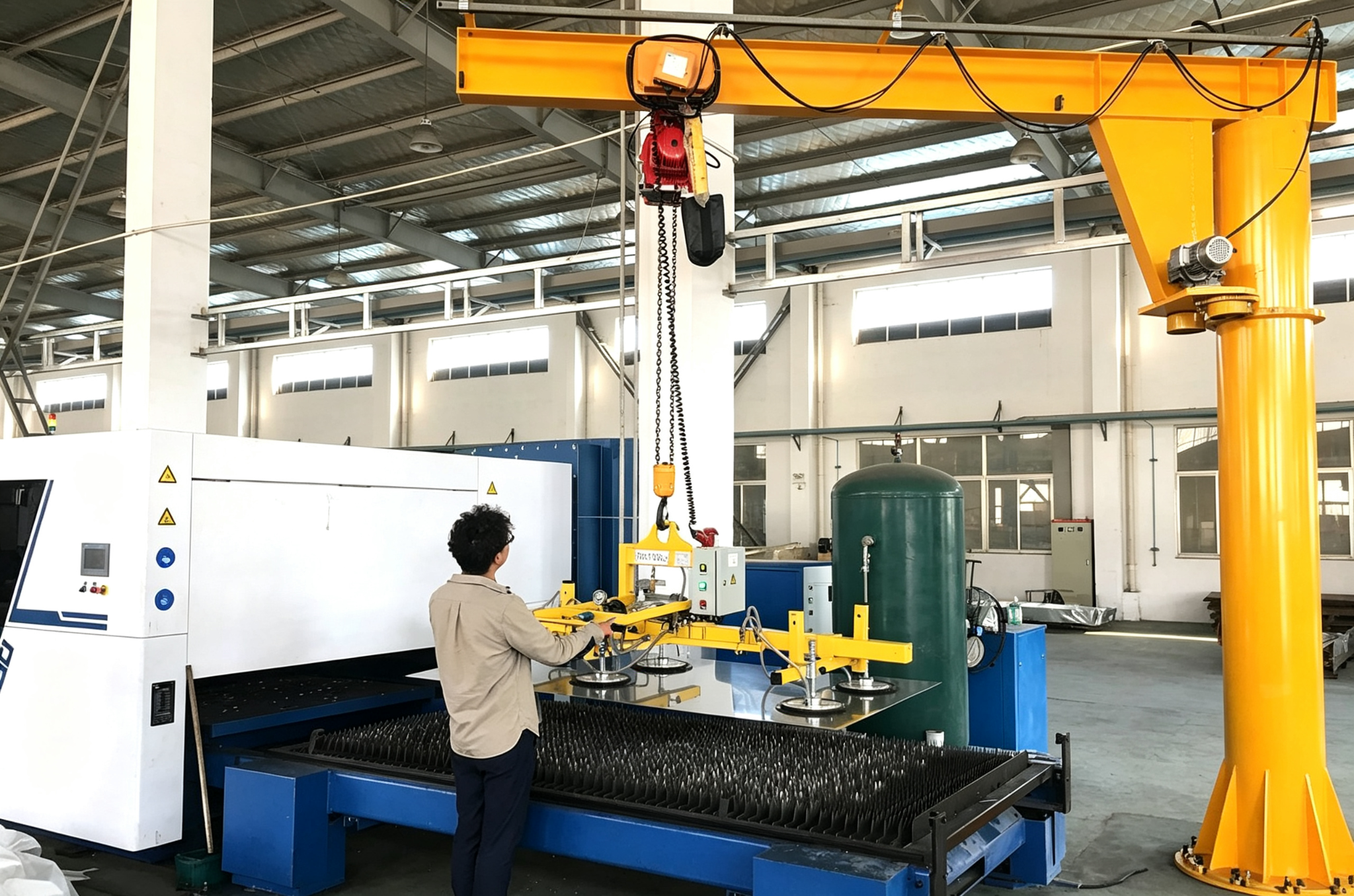
ZOKE free standing jib crane with vacuum lifter in a workshop
Full Use of SpaceA compact column and rotating arm provide efficient coverage of the working area without occupying valuable floor space.
Easy InstallationThe modular structure simplifies foundation installation, assembly, commissioning and future relocation or maintenance.
Flexible Lifting OptionsElectric or manual hoists, pendant or wireless controls and customized arm lengths are available for different applications.
Introduction

Free Standing Jib Crane Structure and Types

A free standing jib crane is a self-supporting lifting system consisting of a vertical column, a slewing mechanism, a horizontal load-bearing jib arm and a hoist. Because it does not rely on the building structure for support, it is well suited to workshops, production lines, loading areas and individual workstations requiring flexible local lifting.

Compared with wall-mounted and wall-travelling jib cranes, floor-mounted jib cranes can provide higher capacities, longer outreach and a wider rotation range. Capacity, arm length, lifting height, rotation angle and control method can be engineered to suit the application. ZOKE focuses on dependable manufacturing quality, structural reliability and application-specific engineering rather than competing on price alone.

1

Fixed Hinge-Shaft Type

  • Rotation angle: up to 270°
  • Typical capacity: up to 1 tonne
  • Typical effective radius: up to 5 m

The jib rotates around a hinge shaft fixed to the column. This compact configuration is suitable for light-duty lifting in restricted work areas.

2

Braced Arm Type

  • Rotation angle: up to 360°
  • Typical capacity: up to 2 tonnes
  • Typical effective radius: up to 5 m

A supporting brace improves the load condition of the main jib, providing greater structural stability for medium-duty workstation lifting.

3

Slewing Bearing Type

  • Rotation angle: up to 360°
  • Typical capacity: up to 6 tonnes
  • Typical effective radius: up to 12 m

The slewing-bearing structure accommodates higher torque, allowing increased lifting capacity and a longer working radius for demanding applications.

Main Components

  1. 1Electric hoist
  2. 2Electrical system
  3. 3Jib arm
  4. 4Slewing structure
  5. 5Column
  6. 6Base plate and anchor system

The supporting floor, foundation and anchor system must be verified by a qualified engineer for the actual crane loads and site conditions. A preliminary soil or foundation bearing capacity of approximately 2,500 lb/ft² (about 120 kPa) may be used as a reference only; final requirements are subject to engineering confirmation.

Why Choose ZOKE

Free Standing Jib Crane Advantages

Compact design, dependable construction and factory-direct engineering make ZOKE free standing jib cranes a practical solution for workstation lifting and localized material handling.

01

Space-Saving Design

The compact structure makes full use of limited workshop space while providing smooth slewing coverage for loading, assembly and repetitive handling tasks.

02

Easy Installation & Operation

Modular construction supports straightforward installation and maintenance. Manual or powered rotation, electric or manual hoists and multiple control options are available.

03

Strong, Durable & Low Noise

A rigid column and reinforced jib arm provide stable lifting performance, dependable service life and smooth, low-noise operation.

04

Factory-Direct Engineering

Work directly with the manufacturer—without trading-company markups. Professional engineers and an independent testing team support selection, customization and inspection.

05

FEM & GB Manufacturing Standards

Design, fabrication and testing follow applicable FEM and GB requirements together with the confirmed capacity, arm length, lifting height, duty class and site conditions.

06

Industrial Surface Protection

Steel structures can be sandblasted before coating, then finished with epoxy zinc-rich primer and chlorinated-rubber topcoat for reliable corrosion protection.

07

Comprehensive Safety Protection

Available protection includes overload limiting, upper and lower lifting limits, low-voltage and power-failure protection. Standard motors are supplied with IP44 protection and Class F insulation.

08

Special-Environment Options

Explosion-proof configurations can be supplied to Ex d IIB T4 or Ex d IIC T4 requirements. Metallurgical versions can use Class H insulation, heat-resistant cables and thermal shielding.

09

Export-Ready Packaging

Components are protected with suitable wooden cases or waterproof wrapping and reinforced according to the selected transportation method.

Components

Explore the principal structural, lifting and control components of a free standing jib crane.

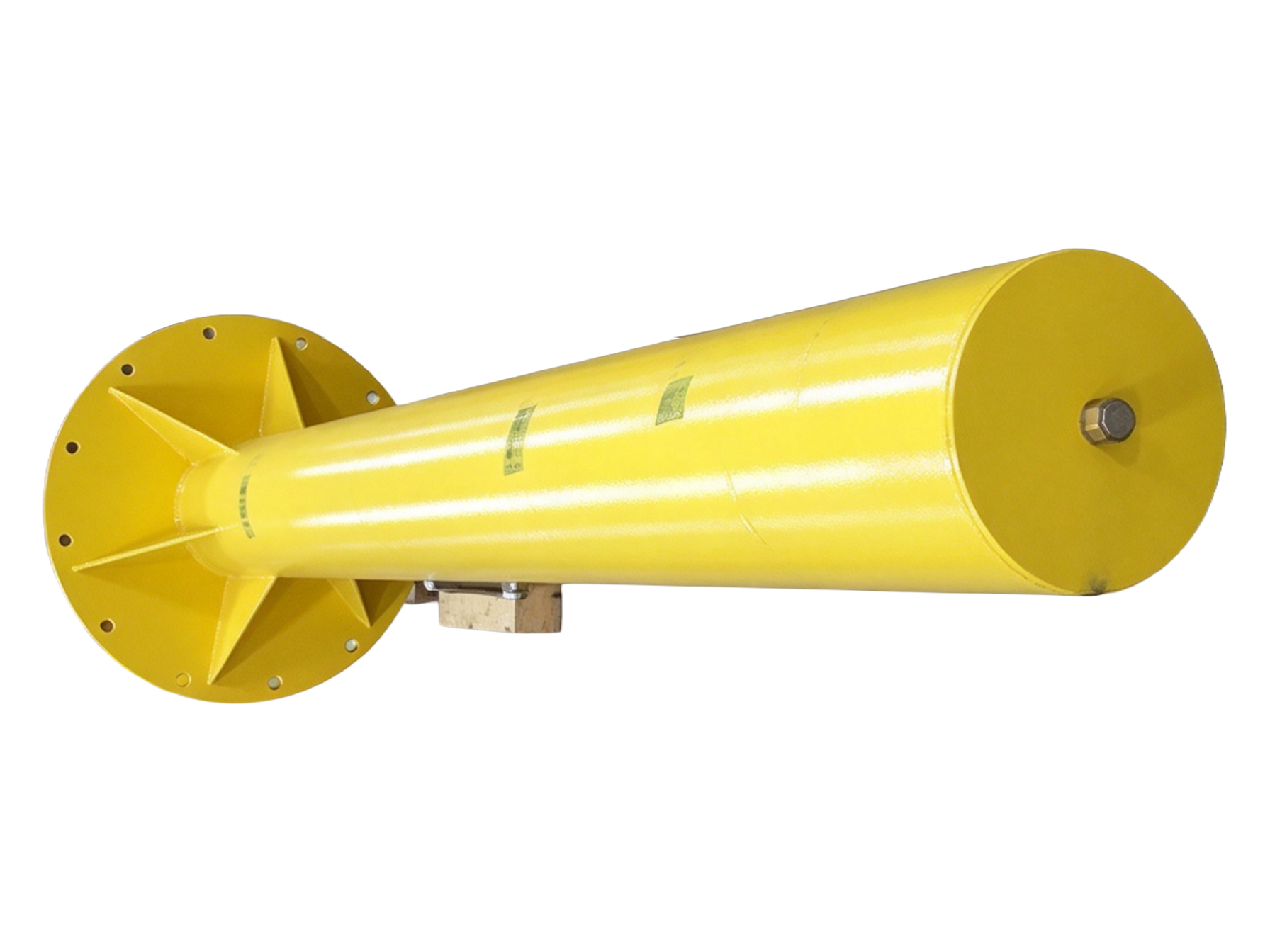
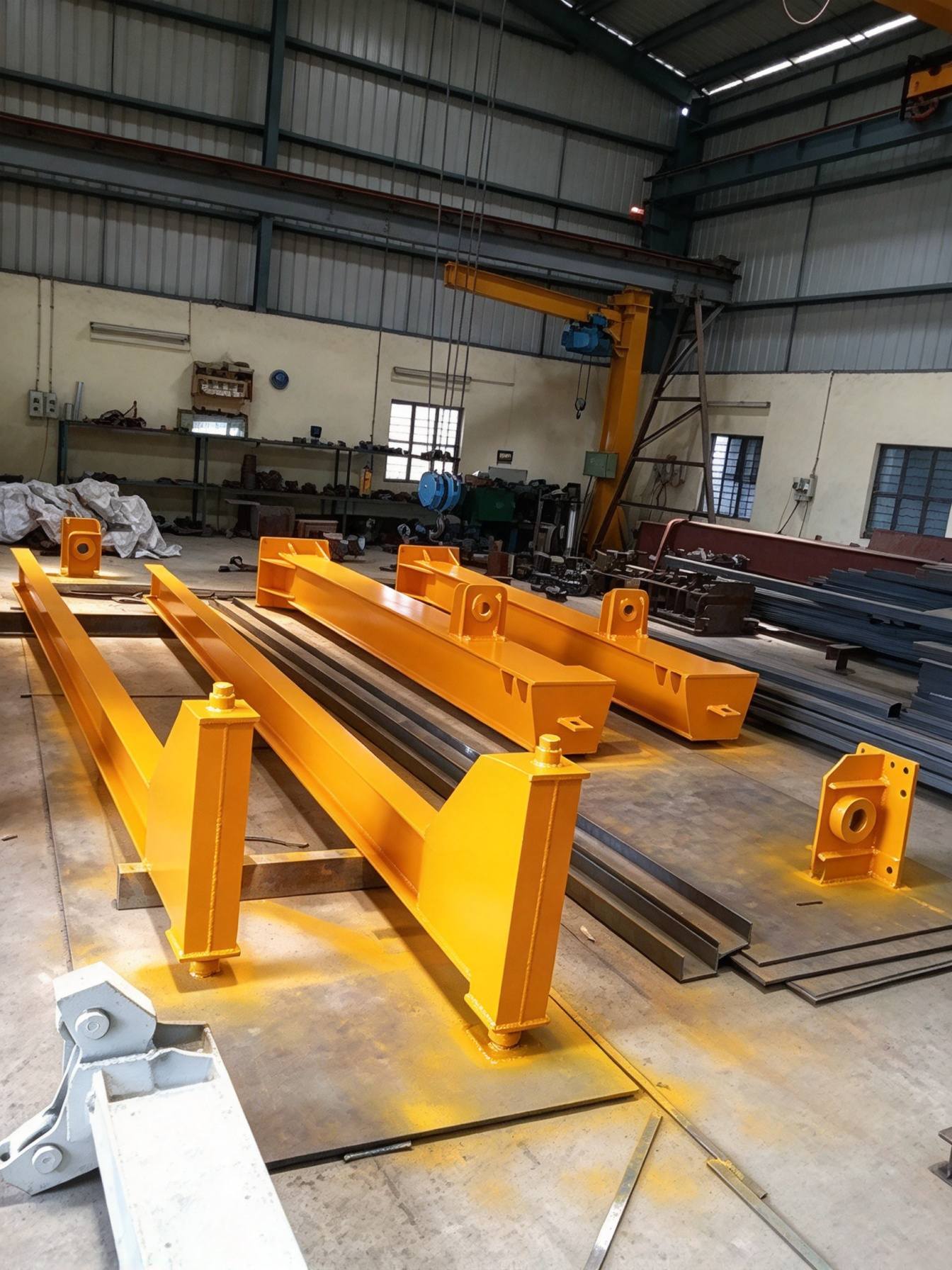
Column
Free standing jib crane column

Column

The self-supporting column transfers vertical, radial and overturning loads to the foundation through the base plate and anchor bolts. Column diameter, wall thickness, height and base configuration are engineered for the required capacity, outreach and rotation range. Controlled fabrication and a corrosion-resistant coating support stable long-term service.

Arm Beam
Free standing jib crane arm beam

Arm Beam

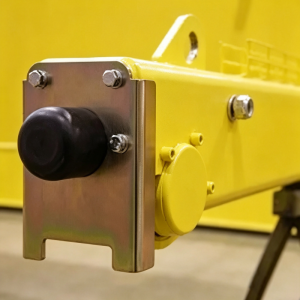
The load-bearing jib arm supports the hoist trolley and defines the crane working radius. I-beam or box-girder construction can be selected according to capacity and outreach. The arm is designed for controlled deflection and smooth trolley travel, with end stops, cable supports and customized arm lengths available.

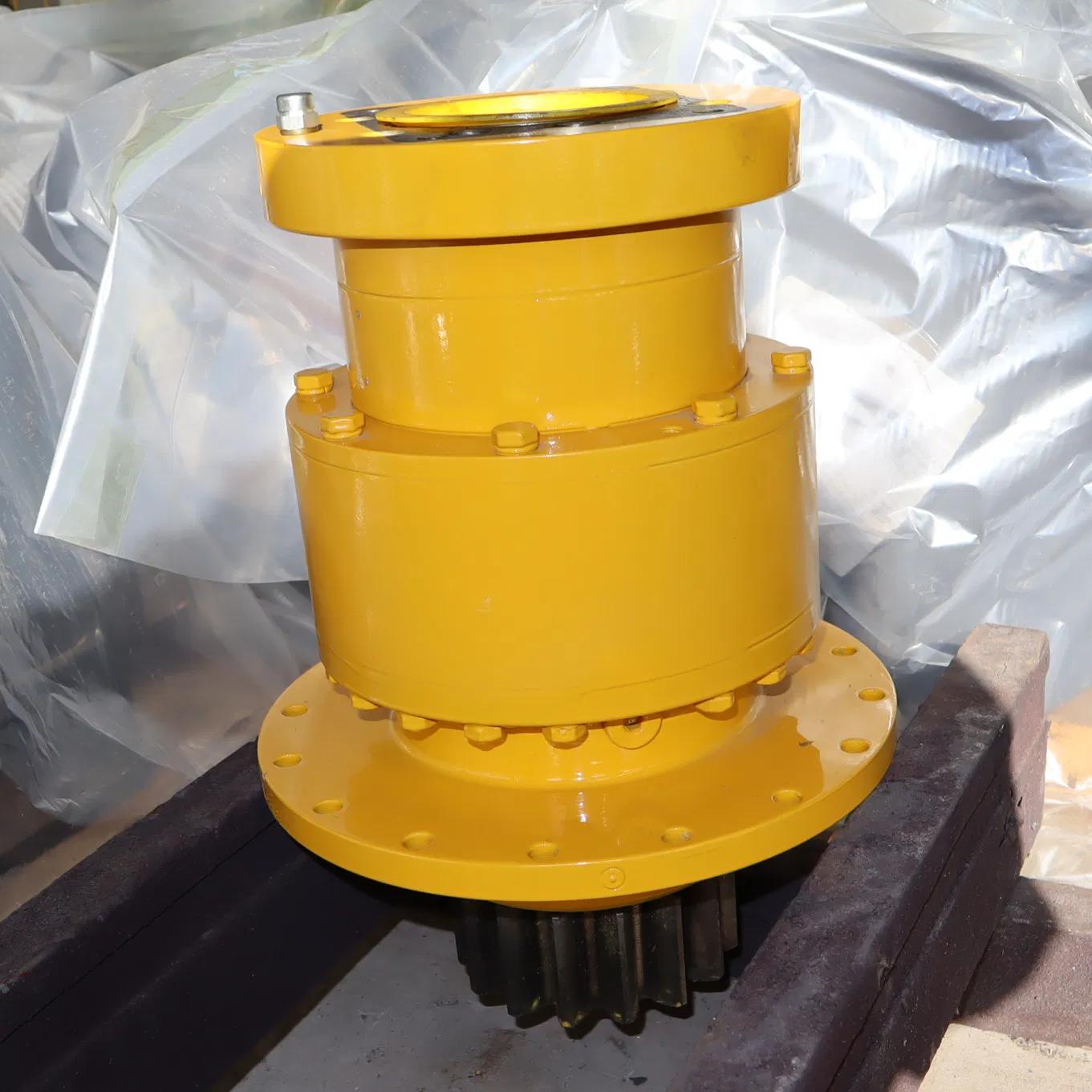
Reducer
Free standing jib crane slewing reducer

Reducer

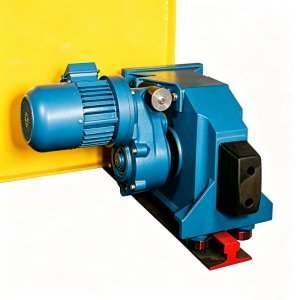
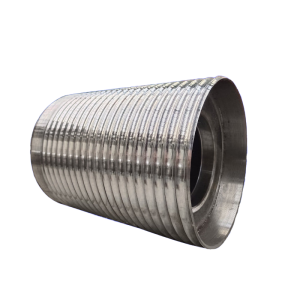
For powered slewing models, the geared reducer provides compact, high-torque rotation with smooth starting and stopping. The drive ratio and motor output are matched to the jib length, rated load and operating frequency. Braking, rotation limits and variable-frequency control can be supplied when required.
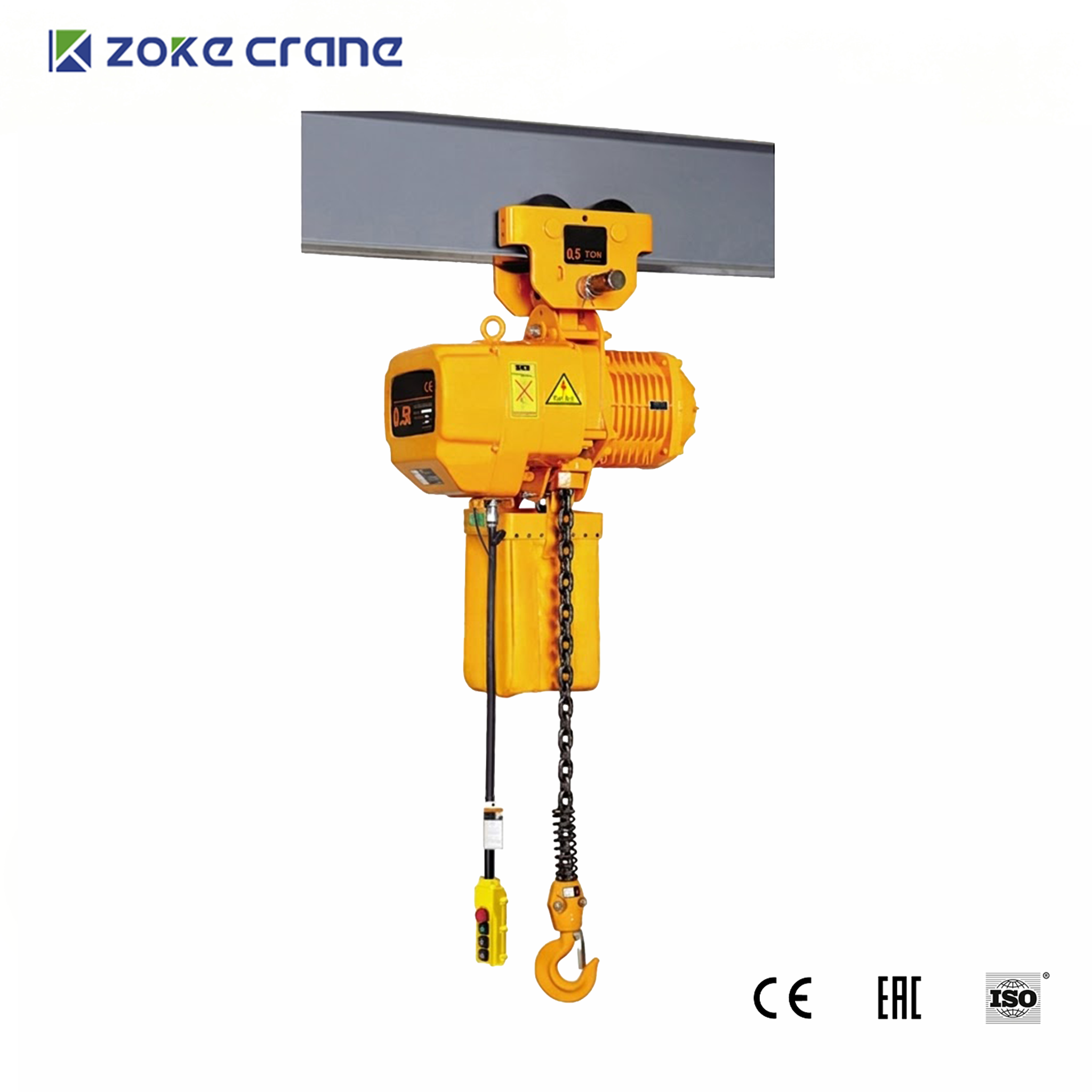
Electric Hoist
Electric chain hoist for free standing jib crane

Electric Hoist

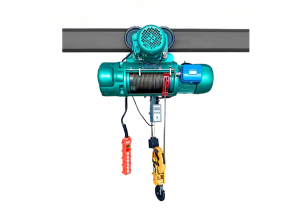
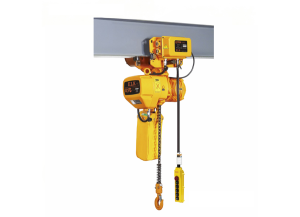
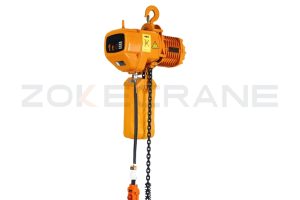
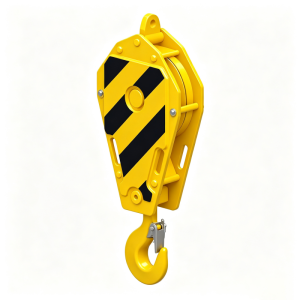
Electric chain or wire rope hoists can be selected to suit capacity, lifting height, speed and duty requirements. Single-speed, dual-speed or variable-frequency lifting is available, together with upper and lower limit switches, overload protection, pendant control and wireless remote control.
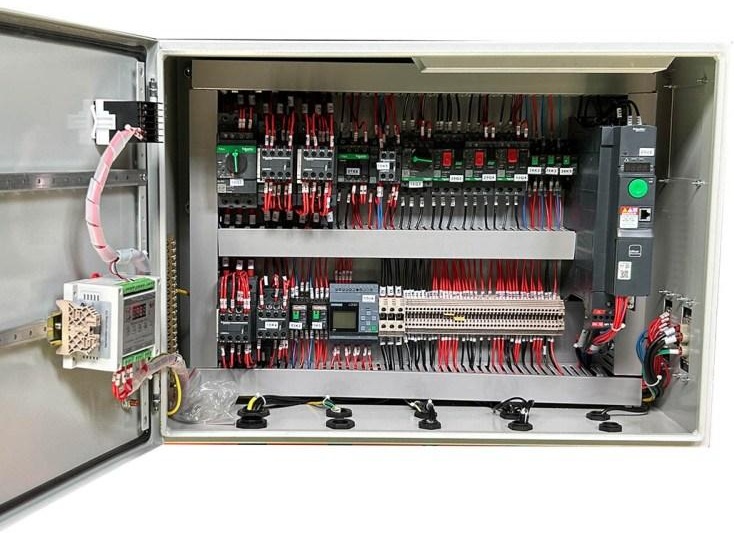
Electrical Cabinet
Free standing jib crane electrical cabinet

Electrical Cabinet

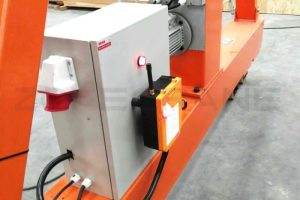
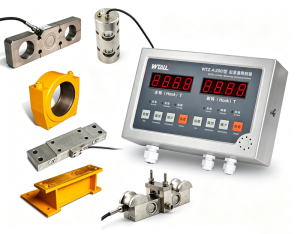
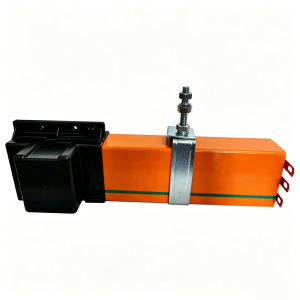
The electrical cabinet organizes control and protection components in a clear, serviceable layout. Standard functions can include short-circuit, overload, phase-loss, undervoltage, emergency-stop and travel-limit protection. Control voltage, power supply, VFD control and remote-control interfaces can be customized for the project.

Final component dimensions, motor ratings, hoist type, slewing arrangement and control configuration are confirmed according to the rated load, arm length, lifting height, duty class and operating environment.
FAQ

Free Standing Jib Crane FAQ

What information is required to select a free standing jib crane?

Please provide the rated capacity, arm length or working radius, lifting height, required rotation angle, power supply, duty class, control method and operating environment. The floor or foundation condition and available installation space are also required for engineering confirmation.

What capacities, arm lengths and lifting heights are available?

Capacity, arm length and lifting height can be engineered to suit the application within the structural limits of the selected jib-crane type. Final dimensions are confirmed according to the load, working radius, duty requirement, building clearance and foundation conditions.

How is a free standing jib crane fixed to the floor?

The column is normally secured to a reinforced concrete foundation using a base plate and anchor bolts. Foundation size, concrete grade and anchor-bolt arrangement must be verified for the actual vertical load, overturning moment and site conditions. A soil or foundation bearing capacity of approximately 2,500 lb/ft² may be used only as a preliminary reference.

Can the rotation be manual or motorized?

Yes. Light-duty models can use manual slewing, while larger or frequently operated cranes can be equipped with a geared motor and reducer. The rotation range can typically be configured from 120° to 360°, with mechanical or electrical rotation limits supplied where required.

Which hoist and control options are available?

Electric chain hoists or wire rope hoists can be selected according to the capacity, lifting height, speed and duty requirements. Pendant control and wireless remote control are available, and the voltage and frequency can be customized for the destination country.

What safety protection is included?

Available protection includes overload limiting, upper and lower lifting limit switches, emergency stop, low-voltage and power-failure protection, motor protection and trolley or slewing travel limits. The final safety scope is matched to the confirmed crane configuration and operating environment.

Tell Us About Your Lifting Requirements

Share the capacity, arm length, lifting height and operating conditions. Our engineers will reply with a suitable solution within 24 hours.